
Hearing the words “blocked artery” from your cardiologist is unsettling enough. Then comes the next question: angioplasty or bypass surgery? Both procedures restore blood flow to a starving heart, but they go about it in very different ways, carry different risks, and suit different patients.
If you or someone you love has just been handed this decision, you’re probably searching for straight answers, not a textbook. This guide breaks down the difference between angioplasty and bypass surgery in plain language, walks through when each one is typically recommended, and compares recovery timelines so you know what to expect either way. None of this replaces a conversation with your cardiologist, but it should make that conversation a lot less intimidating.
What Is Angioplasty?
Angioplasty, also called percutaneous coronary intervention (PCI), is a minimally invasive procedure used to open a narrowed or blocked coronary artery. A cardiologist threads a thin catheter through a blood vessel in your wrist or groin, guides it to the blockage, and inflates a small balloon to push the plaque against the artery wall. In most cases, a small mesh tube called a stent is left behind to keep the artery propped open.
How the Procedure Works
The entire process usually takes 30 minutes to a couple of hours, and patients are typically awake but sedated. Because there’s no large incision and no need to stop the heart, angioplasty is far less physically taxing than open heart surgery. Many people go home the same day or after one night in the hospital.
Stent vs Bypass Surgery: A Quick Distinction
It helps to understand where stents fit into this picture. A stent isn’t a separate treatment, it’s a tool used during angioplasty. So when people compare “stent vs bypass surgery,” they’re really comparing angioplasty (with a stent) against CABG. The stent holds the artery open at the exact site of the blockage, while bypass surgery reroutes blood flow around the blockage entirely using a graft.
What Is Bypass Surgery (CABG)?
Coronary artery bypass grafting, commonly shortened to CABG, is open-heart surgery. Instead of opening the blocked artery from the inside, surgeons take a healthy blood vessel from another part of your body often the chest, leg, or arm and use it to create a new path for blood to flow around the blockage.
What Happens During Bypass Surgery
CABG typically requires general anesthesia, a several-hour operation, and in many cases, temporarily stopping the heart while a heart-lung machine takes over circulation. Surgeons may perform a single bypass or multiple bypasses in one operation, depending on how many arteries are affected. This is major surgery, and the hospital stay usually runs five to seven days, sometimes longer.
Difference Between Angioplasty and Bypass Surgery
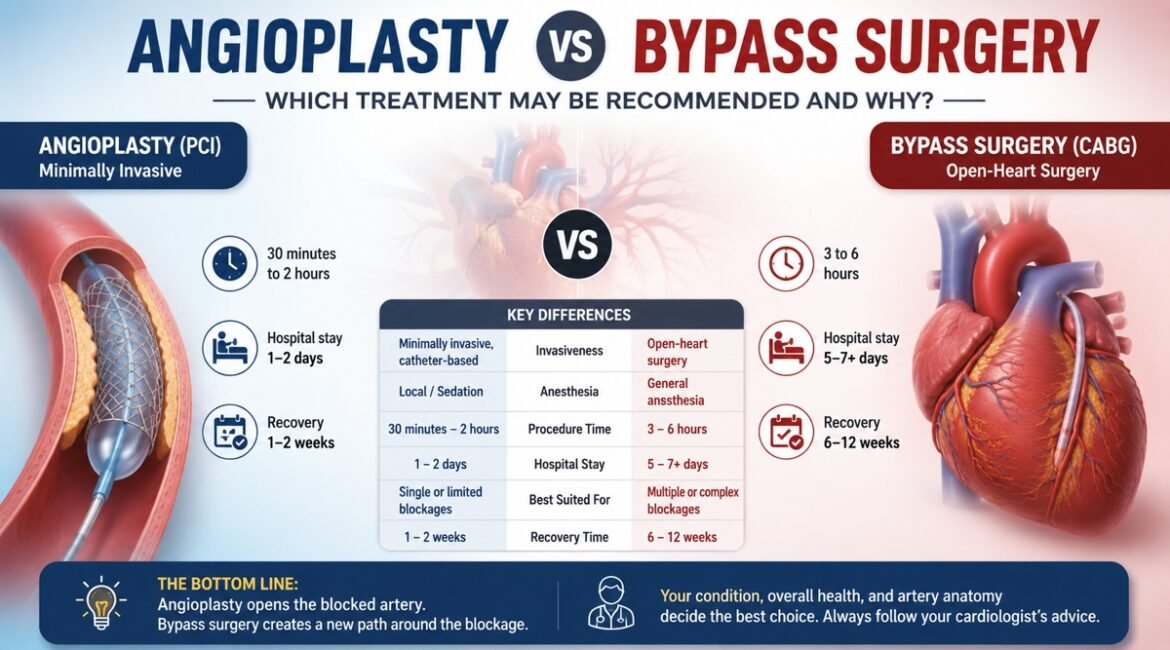
At a glance, the difference between angioplasty and bypass surgery comes down to invasiveness, scope, and recovery:
| Factor | Angioplasty (PCI) | Bypass Surgery (CABG) |
|---|---|---|
| Invasiveness | Minimally invasive, catheter-based | Open-heart surgery |
| Anesthesia | Local/sedation | General anesthesia |
| Procedure time | 30 minutes–2 hours | 3–6 hours |
| Hospital stay | 1–2 days | 5–7+ days |
| Best suited for | Single or limited blockages | Multiple or complex blockages |
| Recovery time | 1–2 weeks | 6–12 weeks |
Angioplasty treats a blockage where it sits. Bypass surgery builds an entirely new route around it. That single distinction explains most of the differences in risk, recovery, and long-term suitability discussed below.
When Is Angioplasty Recommended?
Angioplasty is generally the first choice when the situation allows for a less invasive approach. Cardiologists tend to lean toward angioplasty when:
- Only one or two coronary arteries are blocked, and the blockages are in accessible locations
- A patient is having a heart attack and needs emergency restoration of blood flow (angioplasty can often be performed within hours of symptom onset)
- The patient has other health conditions that make major surgery riskier, such as advanced age, frailty, or lung disease
- Faster recovery and shorter hospital stay are priorities, and the anatomy of the blockage is favorable
Because it’s less invasive, angioplasty is also often used as an urgent, life-saving intervention during a heart attack, when every minute matters and open-heart surgery simply isn’t practical in the moment.
When Is Bypass Surgery Recommended?
Bypass surgery tends to be recommended when the blockages are more extensive or located in areas that are harder to reach with a catheter. Common scenarios include:
- Blockages in multiple coronary arteries, especially three or more
- A blockage in the left main coronary artery, which supplies a large portion of the heart muscle and is considered high-risk
- Patients with diabetes and multi-vessel disease, where research has shown bypass surgery often leads to better long-term outcomes
- Cases where angioplasty has already been tried and the artery has narrowed again (restenosis)
- Complex plaque patterns, such as heavy calcification, that make stent placement difficult or less durable
In short, bypass surgery is usually the go-to option when the disease is widespread rather than confined to one or two spots.
Angioplasty vs Bypass Surgery: Which Is Better?
There’s no universal answer to “angioplasty vs bypass surgery which is better” the right choice depends entirely on the individual’s anatomy, overall health, and how many arteries are involved. That said, here’s how the two generally compare:
For single or double-vessel disease in patients with good heart function, angioplasty often delivers similar long-term survival with less downtime, making it an appealing option.
For extensive, multi-vessel disease particularly in people with diabetes or reduced heart pumping function studies consistently show bypass surgery tends to offer better long-term survival and fewer repeat procedures.
Which Is Safer, Angioplasty or Bypass Surgery?
In terms of immediate procedural risk, angioplasty is generally considered safer in the short term because it avoids major surgery, general anesthesia, and a lengthy recovery. However, “safer” isn’t the same as “more effective for every case.” Bypass surgery carries higher upfront surgical risk but can offer more durable, long-term protection for people with complex or widespread blockages. Your care team weighs both the immediate risk and the long-term outlook before making a recommendation, it’s rarely a simple either/or decision.
Angioplasty vs Bypass Surgery Recovery
Recovery is one of the biggest practical differences patients notice, and it’s often a deciding factor when both options are medically reasonable.
Recovering From Angioplasty
Most people are up and walking within a day and back to light daily activities within a week. Strenuous activity, heavy lifting, and driving typically resume within one to two weeks, though your cardiologist will confirm the timeline based on your specific case. The main things to watch during recovery are the small incision site (wrist or groin) and any new chest symptoms.
Recovering From Bypass Surgery
Recovery from CABG is a longer road. Expect a hospital stay of about a week, followed by six to twelve weeks of gradual recovery at home. Cardiac rehabilitation a structured program of supervised exercise and education plays a big role in getting patients back to full strength safely. Fatigue, soreness around the incision, and gradually increasing activity levels are all part of the normal healing process.
Regardless of which procedure you have, both paths generally include lifestyle changes afterward: a heart-healthy diet, regular activity, medication adherence, and follow-up appointments to monitor your progress.
Angioplasty vs Bypass Surgery for Blocked Arteries: Making the Decision
When it comes to angioplasty vs bypass surgery for blocked arteries, your cardiology team looks at several factors together, not in isolation:
- Number of blocked arteries — one or two versus three or more
- Location of blockages — including whether the left main artery is involved
- Heart pumping function — measured by ejection fraction
- Other health conditions — diabetes, kidney disease, lung disease, or frailty
- Urgency — whether this is a planned procedure or an emergency
- Patient preference — recovery time, lifestyle, and personal risk tolerance all matter
Many hospitals use a “heart team” approach, where an interventional cardiologist and a cardiac surgeon jointly review the case and discuss both options with the patient before a final decision is made.
Risks and Complications to Understand
Every heart procedure carries some risk, and understanding what those risks look like for each option can make the decision feel less abstract.
Risks Associated With Angioplasty
Because angioplasty is catheter-based, the most common risks are related to the access site and the artery itself: bruising or bleeding where the catheter was inserted, a small risk of the artery re-narrowing over time (restenosis), and a rare risk of blood clot formation within the stent. Serious complications like heart attack, stroke, or the need for emergency bypass surgery during the procedure are uncommon but not impossible, which is why angioplasty is always performed in a hospital equipped to handle them.
Risks Associated With Bypass Surgery
As major surgery, CABG carries a broader set of risks: infection at the incision site, bleeding requiring transfusion, irregular heart rhythms (particularly atrial fibrillation) in the days after surgery, and in a small percentage of cases stroke or kidney complications related to the heart-lung machine. Older patients or those with multiple existing health conditions face a somewhat higher risk profile, which is one reason your surgical team will review your full medical history before recommending this route.
It’s worth remembering that both procedures are performed thousands of times every year with well-established safety records. Hospitals track outcomes closely, and your cardiology team will walk you through your personal risk profile not just national averages before you consent to either option.
Cost and Long-Term Considerations
Cost is rarely the deciding factor in an emergency, but for planned procedures, it’s a legitimate part of the conversation. Angioplasty is generally less expensive upfront due to the shorter procedure and hospital stay, though the difference narrows if multiple stents are needed or if a repeat procedure becomes necessary down the line. Bypass surgery has a higher initial cost tied to the operating room time, surgical team, and extended hospital stay, but for the right candidate, it can reduce the likelihood of needing another intervention for many years. Discussing expected costs, insurance coverage, and the likelihood of future procedures with your care team can help you plan realistically, not just medically but financially.
Life After the Procedure
Whichever path you take, the procedure itself is really just the starting point. Long-term heart health depends heavily on what happens afterward:
- Medications — Blood thinners, cholesterol-lowering drugs, and blood pressure medications are typically prescribed and should be taken consistently, even after you start feeling better.
- Cardiac rehabilitation — A supervised program of exercise, education, and support that’s strongly recommended after both angioplasty and bypass surgery, and shown to improve long-term outcomes.
- Diet and activity — Reducing saturated fat and sodium, staying physically active, and maintaining a healthy weight all help protect the arteries — including any new grafts or stents.
- Quitting smoking — One of the single most impactful changes a patient can make, regardless of which procedure they had.
- Regular follow-up — Ongoing check-ins with your cardiologist help catch any new narrowing or symptoms early, before they become emergencies.
Frequently Asked Questions
Is angioplasty or bypass surgery a permanent fix? Neither procedure cures coronary artery disease. Both restore blood flow to the heart, but the underlying disease can progress if risk factors like high cholesterol, high blood pressure, smoking, and inactivity aren’t managed afterward.
Can I choose angioplasty even if my doctor recommends bypass surgery? This is a conversation to have directly with your cardiology team. In some cases, patient preference is factored in, but for extensive multi-vessel disease, bypass surgery may offer meaningfully better long-term outcomes, and your doctor will explain why they’re recommending one path over the other.
How long do stents last after angioplasty? Modern drug-eluting stents are designed to remain in place permanently and generally perform well for many years. Regular follow-up and medication (often a blood thinner) help reduce the risk of the artery re-narrowing.
Is bypass surgery riskier than angioplasty? Bypass surgery carries higher short-term surgical risk since it’s a major open-heart operation, while angioplasty is less invasive with a quicker recovery. However, for extensive blockages, bypass surgery may provide better long-term durability, so “riskier” depends on what timeframe and outcome you’re measuring.
Which recovery is faster, angioplasty or bypass surgery? Angioplasty recovery is significantly faster often one to two weeks compared to six to twelve weeks for bypass surgery, which involves a longer hospital stay and a more gradual return to normal activity.
Talk to Your Cardiologist About the Right Path Forward
Choosing between angioplasty and bypass surgery isn’t a decision you have to make alone. Both procedures have helped millions of people regain healthy blood flow and get back to their lives the “right” one simply depends on your unique heart anatomy, overall health, and goals for recovery. If you’ve recently been diagnosed with a blocked artery, the best next step is a detailed conversation with your cardiologist or a cardiac surgeon about your specific test results, so you can make this decision with clarity and confidence rather than guesswork.