
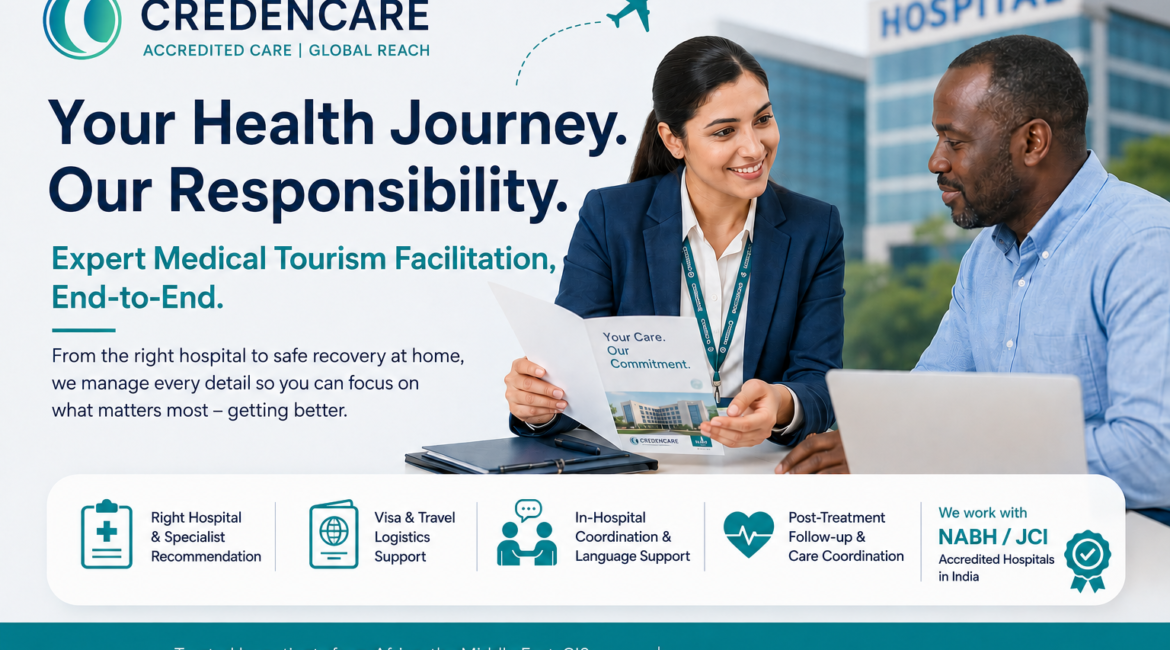
You’ve done your research. You know the treatment you need. You’ve even found a hospital in India that looks promising. But now comes the harder part – the visa, the appointments, the language barrier, the follow-up care, the sheer logistics of receiving medical treatment thousands of miles from home.
This is exactly where a medical tourism facilitator steps in.
Most people don’t know this role exists until they’re already overwhelmed. A facilitator isn’t a travel agent who books flights and hotels. They’re a dedicated professional or a specialized organization, who manages the full arc of your medical journey, from the first inquiry to the moment you walk back through your front door.
In this article, you’ll learn exactly what a medical tourism facilitator does, why their role is different from a broker or agent, what genuine end-to-end medical travel assistance looks like, and how to choose one you can actually trust.
What Is a Medical Tourism Facilitator?
A medical tourism facilitator is a professional intermediary who bridges the gap between international patients and healthcare providers abroad. Think of them as your personal guide, advocate, and coordinator, all rolled into one.
Their job is not to perform medical procedures. Their job is to make sure you reach the right doctor, at the right hospital, at the right time and that everything in between is handled so you can focus on getting better.
Facilitators work with patients traveling for a wide range of treatments: cardiac surgery, orthopedic procedures, cancer care, fertility treatments, dental work, and more. In the context of India-based medical tourism, a good facilitator connects patients from Africa, the Middle East, CIS countries, and South and Southeast Asia with hospitals that meet internationally recognized quality benchmarks.
The Difference Between a Medical Tourism Facilitator and a Broker
This distinction matters more than most patients realize.
A broker functions transactionally. They connect you with a hospital, collect a referral fee, and their involvement typically ends there. There’s no ongoing accountability, no quality vetting, no care if things go sideways mid-treatment.
A genuine medical tourism facilitator operates very differently. Their work doesn’t end when you book a bed. It continues through:
- Pre-travel medical assessment and documentation review
- Hospital and doctor recommendations based on your specific diagnosis
- Appointment scheduling and specialist coordination
- Visa and travel logistics support
- Airport pickup and local ground arrangements
- In-hospital interpretation and communication support
- Discharge planning and post-treatment follow-up
The distinction comes down to accountability. A broker earns their fee at booking. A facilitator earns theirs by making sure your entire experience goes well.
When you’re choosing between the two, ask one simple question: “What happens if something goes wrong during my treatment?” A broker may have no answer. A facilitator should have a clear one.
What Does End-to-End Medical Travel Assistance Actually Look Like?
“End-to-end” is a phrase that gets used loosely. Here’s what it should mean in practice.
Before You Travel
Your facilitator reviews your medical history, diagnosis, and treatment documents. They identify the most appropriate hospitals and specialists not just any hospital, but one genuinely suited to your condition. If accreditation matters to you (and it should), they’ll filter for hospitals with recognized quality certifications like NABH (National Accreditation Board for Hospitals & Healthcare Providers) in India, which aligns with international standards.
They’ll also help you understand realistic cost estimates, coordinate your medical visa application, and brief you on what to pack, what to expect, and how long you’ll likely need to stay.
During Your Treatment
Once you land, your facilitator or their local representative, handles ground coordination. This includes transport from the airport, hotel arrangements near the hospital, scheduling pre-operative consultations, and being available as a point of contact between you and the clinical team.
Language is one of the most underestimated barriers in international healthcare. A good facilitator ensures nothing gets lost in translation not your symptoms during consultation, not post-operative instructions, not discharge paperwork.
After You Return Home
The care doesn’t stop at discharge. Your facilitator coordinates with your treating physician to share post-treatment reports with your home doctor, answers follow-up questions, and helps you navigate any complications that arise in the weeks after your return.
This last phase is where many facilitators fall short and where the best ones prove their worth.
How an International Patient Coordinator Manages Hospital Coordination
One of the most valuable things a medical travel coordinator for foreign patients does is manage the relationship with the hospital on your behalf.
Hospitals abroad, even excellent ones are busy institutions. When you’re a foreign patient without a local contact, you’re often left waiting longer for responses, uncertain about billing, and unclear on treatment timelines.
Your facilitator changes that dynamic. Because they work regularly with certain hospitals, they have established relationships with patient services teams, billing departments, and clinical coordinators. They know who to call. They know the right questions to ask. And they have a track record that hospitals take seriously.
This ongoing relationship with hospitals also means your facilitator has genuine insight into quality and patient experience, not just what appears on a hospital’s website, but what patients actually report after treatment.
For NABH-accredited hospitals in India, this matters particularly. NABH accreditation ensures that a hospital meets specific standards across patient safety, clinical outcomes, staff qualifications, and infection control. A facilitator who understands NABH can help you distinguish between hospitals that are genuinely committed to quality and those that are simply well-marketed.
How to Choose a Medical Tourism Facilitator You Can Trust
Finding the right facilitator is one of the most important decisions you’ll make. Here’s what to look for.
Transparency Over Salesmanship
A trustworthy facilitator doesn’t push you toward a specific hospital before understanding your medical condition. They ask questions first. They want to see your reports. If a facilitator immediately recommends a hospital without reviewing your diagnosis, that’s a warning sign, they may be driven by referral commissions rather than your clinical needs.
Hospital Vetting Credentials
Ask how they select the hospitals they work with. Do they visit facilities in person? Do they check accreditation status? Do they track patient outcomes? The answer tells you whether their recommendations are based on genuine quality assessment or a business arrangement.
Clarity on Costs and No Hidden Fees
Medical tourism should offer cost savings, but those savings disappear quickly with undisclosed fees. A good facilitator provides a clear, itemized estimate upfront. Accommodation, interpreter services, local transport, all of it should be visible before you commit.
Communication and Accessibility
You should be able to reach your facilitator. Not just during business hours. If something happens at 2 a.m before your surgery, someone should be reachable. Ask how they handle emergencies before you sign up.
Experience with Your Country and Condition
A facilitator who has worked with patients from your country understands your documentation requirements, your cultural expectations, and likely speaks your language or has staff who do. And one who has experience with your specific medical condition is better placed to guide you to the right specialist.
Why NABH Accreditation Should Be Part of Your Conversation
If you’re traveling to India for medical care, NABH accreditation is one of the most meaningful quality signals you can look for.
NABH – the National Accreditation Board for Hospitals & Healthcare Providers – is a constituent board of the Quality Council of India. Its standards cover over 100 elements across patient care, safety protocols, infrastructure, and clinical governance. Hospitals that achieve NABH accreditation have been independently assessed and found to meet a rigorous benchmark.
For international patients, NABH accreditation reduces the uncertainty of seeking care in an unfamiliar system. It signals that the hospital follows documented protocols, that staff are trained to defined standards, and that there is a formal mechanism for handling patient complaints and adverse events.
A skilled international patient coordinator understands NABH accreditation deeply, not just as a marketing credential, but as a clinical and operational framework. They can explain what a hospital’s accreditation status actually means for your specific treatment.
Frequently Asked Questions
Q: Is a medical tourism facilitator the same as a medical travel agent?
No. A medical travel agent typically handles logistics, flights, accommodation, and basic scheduling. A medical tourism facilitator manages the clinical coordination, hospital vetting, documentation review, interpreter services, and post-treatment follow-up. The scope is significantly broader and more medically focused.
Q: Do medical tourism facilitators charge patients directly?
This varies. Some facilitators charge patients a service fee. Others are compensated through arrangements with partner hospitals. The key is transparency: ask upfront how your facilitator is compensated and whether their hospital recommendations are influenced by commercial arrangements.
Q: How do I know if a hospital recommended by my facilitator is actually good?
Ask for the hospital’s accreditation status – NABH accreditation in India is a reliable indicator of quality. Also ask your facilitator about patient outcomes for your specific procedure, how long they’ve been working with that hospital, and whether they’ve visited the facility personally.
Q: Can a medical tourism facilitator help with the visa process?
Most experienced facilitators provide guidance on the medical visa process, including the documentation hospitals need to provide for your visa application. While they cannot apply on your behalf, they know exactly what’s required and can help ensure nothing is missing.
Q: What should I do if something goes wrong during my treatment abroad?
This is the most important question to ask your facilitator before you travel. A reliable facilitator has a clear protocol for medical emergencies, including relationships with senior hospital staff and the ability to escalate issues quickly. If your facilitator doesn’t have a clear answer, that’s a sign to look elsewhere.
Conclusion
Seeking medical treatment abroad is a significant decision, one that carries real risk if you navigate it without proper support. A qualified medical tourism facilitator doesn’t just make the process easier. They make it safer, more transparent, and significantly less stressful.
The right facilitator brings hospital expertise, clinical knowledge, logistics management, and genuine accountability to your care journey. They’re not just arranging a trip, they’re taking responsibility for your experience.
At Credencare, we work exclusively with NABH/JCI-accredited hospitals in India, vetting every partner on quality, patient experience, and clinical outcomes. We serve patients from Africa, the Middle East, CIS countries, and South and Southeast Asia, and we handle every step of the journey, from your first inquiry to your final follow-up.
If you’re exploring medical treatment in India and want to understand your options without any sales pressure, reach out to us. We’ll start with your medical reports, not our preferred hospital list.