
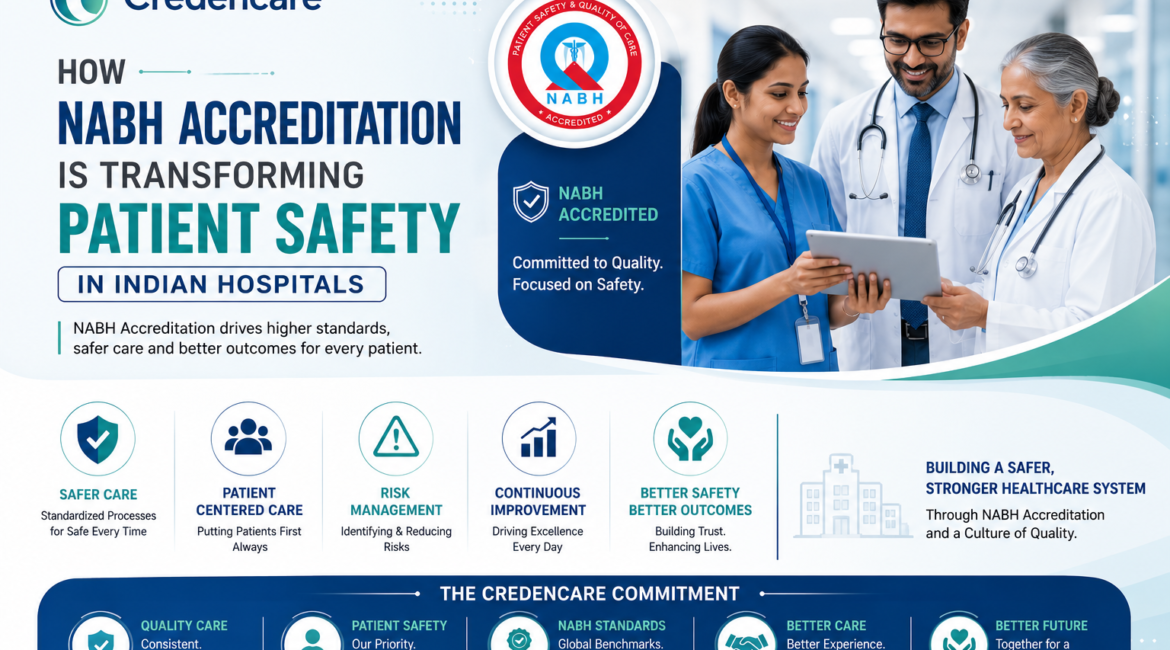
Every time you walk into a hospital, you place your life in the hands of strangers. You trust that the doctors are qualified, the equipment is sterilised, and the systems in place will protect you if something goes wrong. But how do you actually know? In India, where the healthcare landscape ranges from world class tertiary centres to underfunded district facilities, that question matters more than ever.
This is where NABH Accreditation steps in. The National Accreditation Board for Hospitals and Healthcare Providers (NABH) has quietly become one of the most powerful forces reshaping hospital safety standards across India. From reducing medication errors to enforcing rigorous infection control protocols, NABH Accredited hospitals are setting a measurably higher bar for patient centred care.
In this article, you will learn what NABH accreditation actually involves, why it matters for patient safety, how it is changing clinical governance inside hospitals, and what to look for when choosing a hospital for yourself or your family.
What Is NABH Accreditation and Why Does It Matter?
NABH is a constituent board of the Quality Council of India (QCI), established under the Ministry of Commerce and Industry. It was created specifically to set and enforce quality standards across healthcare organisations in India, functioning much like the Joint Commission does in the United States or the Care Quality Commission in the United Kingdom.
At its core, NABH Accreditation is a formal, third party assessment of whether a hospital meets a defined set of patient safety standards, quality benchmarks, and clinical governance requirements. It is entirely voluntary, which means hospitals that pursue it are actively choosing to be held accountable to a higher standard.
The Scope of NABH Hospital Accreditation in India
NABH evaluates hospitals across ten chapters covering every aspect of care delivery. These include patient access and assessment, care of patients, management of medication, patient rights and education, hospital infection control, continuous quality improvement, facility management, and human resource management, among others. Each chapter contains dozens of measurable standards and objective elements, making the assessment rigorous and comprehensive rather than tick – box.
As of recent data, over 700 hospitals across India hold full NABH Accreditation, with thousands more enrolled in its entry level and pre-accreditation progressive programmes. States like Maharashtra, Tamil Nadu, Karnataka, and Delhi have seen particularly strong uptake.
The Direct Impact of NABH on Patient Safety Outcomes
The phrase “patient safety” can sound abstract, but in practice it translates into very concrete situations: a nurse catching a medication dosage error before it reaches the patient, a surgeon pausing to verify they are operating on the correct site, a ward that properly isolates a patient with a drug resistant infection. NABH standards are specifically designed to build systems that make these interventions the default, not the exception.
Medication Safety and Error Reduction
One of the most significant areas of impact is medication management. NABH-accredited hospitals are required to maintain standardised drug labelling, implement high alert medication protocols and conduct regular audits of prescription and dispensing accuracy. Studies comparing NABH Accredited facilities with non-accredited ones have consistently shown lower rates of adverse drug events in accredited hospitals, a direct result of structured pharmacy governance and nursing checks embedded into daily workflow.
Surgical Safety and the Power of Checklists
NABH mandates the use of WHO-recommended surgical safety checklists as a non-negotiable standard. This means that before any procedure, teams are required to confirm patient identity, verify the surgical site, check for allergies, confirm equipment availability, and conduct a post procedure debrief. While checklists may seem simple, the evidence behind them is extraordinary. The WHO’s own data shows that surgical safety checklists reduce complications by up to 36% and deaths by nearly 47% when consistently applied.
In the Indian context, where operating theatres can be under intense pressure and understaffed, the formalisation of these checks through an accreditation requirement has been genuinely life saving.
Infection Control: How NABH Standards Are Combating HAIs
Healthcare associated infections (HAIs) are among the most preventable causes of patient harm globally, and India is no exception. Infections acquired in hospital settings, from catheter-associated urinary tract infections to ventilator-associated pneumonias, add enormous cost, suffering, and mortality to an already burdened system.
NABH’s infection control chapter is one of its most demanding. Accredited hospitals must establish a formal Hospital Infection Control Committee (HICC), develop and update infection control policies, maintain surveillance data on HAI rates, and demonstrate continuous improvement over time. Staff training on hand hygiene, sterilisation protocols, and biomedical waste management is not optional: it is assessed.
Real World Results in Indian Hospitals
Hospitals that have gone through the NABH accreditation process frequently report measurable reductions in their HAI rates. Apollo Hospitals, Fortis Healthcare, and Manipal Hospitals, all of which hold NABH Accreditation, have published internal data showing declines in catheter-associated bloodstream infections after systematically implementing NABH required bundles. For patients in the ICU, this is not a statistic: it is the difference between a smooth recovery and a prolonged, potentially fatal complication.
Clinical Governance and Quality Improvement Under NABH
Clinical governance is the framework through which healthcare organisations are accountable for continuously improving the quality of their services and safeguarding high standards of care. In practical terms, it means that a hospital does not just deliver care: it actively monitors, measures, and improves how it delivers care.
Before NABH became more widely adopted in India, clinical governance in many hospitals was informal or reactive. Problems came to light through complaints, adverse events, or inspections, but rarely through proactive internal monitoring. NABH has fundamentally changed that culture in the hospitals that have gone through the process.
Key Quality Improvement Mechanisms Required by NABH
- Regular clinical audits that compare actual practice against evidence based guidelines
- Root cause analysis (RCA) for every sentinel event and near-miss incident
- Credentialing and privilege management to ensure only qualified staff perform specific procedures
- Mortality and morbidity review meetings that are documented and acted upon
- Patient feedback systems with mandatory follow-up on negative outcomes
Together, these mechanisms create a learning health system, one that treats every adverse event as data and every data point as an opportunity to improve. This is the essence of risk management in modern healthcare, and NABH has made it a structural requirement rather than a good intention.
Patient Centred Care: Putting People, Not Just Protocols, First
One of the most meaningful shifts that NABH drives is the move toward genuine patient centred care. This goes well beyond clinical outcomes. It encompasses how patients are communicated with, whether their rights are respected, how they are involved in decisions about their own treatment, and whether they leave the hospital feeling heard and safe.
Patient Rights, Informed Consent, and Communication Standards
NABH standards require hospitals to have a clearly defined and communicated patient rights policy, accessible to every patient from the moment of admission. This includes the right to receive information about their diagnosis and treatment in language they understand, the right to refuse treatment, the right to privacy and confidentiality, and the right to raise grievances through a formal mechanism.
For millions of patients in India who have historically been treated as passive recipients of care rather than active participants, these standards represent a meaningful cultural shift. Hospitals seeking or maintaining NABH accreditation must demonstrate through documentation, staff interviews, and patient surveys that these rights are not just printed on a wall but are actively practised.
Discharge Planning and Continuity of Care
NABH also addresses what happens after the patient leaves the hospital. Accreditation standards require structured discharge summaries that include diagnosis, treatment provided, medications prescribed, follow-up instructions, and warning signs to watch for. This sounds basic, but in a country where patients frequently travel long distances for treatment and return to areas with limited primary care, a well prepared discharge summary can be the difference between a safe recovery and a dangerous deterioration.
Challenges and the Road Ahead for Hospital Accreditation in India
It would be misleading to present NABH accreditation as a perfect solution without acknowledging the real obstacles that remain. The accreditation process is expensive and resource intensive, which creates a significant barrier for smaller and rural hospitals that may lack the capital or staffing to implement the required systems. This means that the patients who arguably need the protection of accreditation most, those in underserved areas, often have the least access to NABH Accredited facilities.
There is also a well-documented risk of “accreditation fatigue,” where hospitals invest heavily in systems and documentation to pass the assessment and then relax their standards in the years between re-accreditation cycles. NABH has tried to address this through its progressive accreditation pathways and surprise surveillance assessments, but sustaining quality culture remains an ongoing challenge.
Government Initiatives Linking NABH to Healthcare Policy
Positively, the Indian government has begun integrating NABH accreditation into national healthcare programmes. Under Ayushman Bharat and the National Health Mission (NHM), NABH Accredited hospitals receive preferential empanelment and higher reimbursement rates for government-funded procedures. This creates a financial incentive for more hospitals to pursue accreditation, which should gradually broaden patient access to accredited care, particularly in Tier-2 and Tier-3 cities.
What NABH Accreditation Means When You Are Choosing a Hospital
When you or a family member needs hospital care, NABH accreditation is one of the most reliable quality signals available to you as a patient. It does not guarantee a perfect outcome, because medicine never can, but it does mean that the hospital has been assessed by an independent body against rigorous national standards, and found to meet them.
You can verify a hospital’s NABH Accreditation status directly on the website (credencare.com), which maintains a publicly accessible list of all accredited and registered hospitals. When visiting a hospital, look for the NABH accreditation certificate displayed prominently, which should include the accreditation number and validity period.
Beyond the certificate itself, an accredited hospital should be able to tell you their current infection rates, their patient satisfaction scores, and their adverse event reporting processes. If a hospital is uncomfortable sharing this information, that in itself is a meaningful signal.
Frequently Asked Questions About NABH Accreditation
Q1. What is the difference between NABH accreditation and NABL accreditation?
NABH (National Accreditation Board for Hospitals and Healthcare Providers) accredits entire hospital organisations against patient safety and quality standards. NABL (National Accreditation Board for Testing and Calibration Laboratories) separately accredits clinical laboratories and diagnostic centres for technical competence. A hospital can hold both, independently, and many large facilities do.
Q2. How long does it take to get NABH accreditation?
The timeline varies by hospital size and existing systems, but most hospitals take between 10 months and 14 months to achieve full NABH accreditation from the point of beginning preparation. The process involves a self assessment, a pre assessment visit, addressing identified gaps, and then a formal assessment by a team of trained NABH assessors. Once accredited, hospitals must undergo surveillance assessments and re-accreditation every four years.
Q3. Does NABH accreditation cost more for patients?
Not necessarily. While the hospital bears the cost of achieving and maintaining accreditation, the standards themselves do not mandate higher fees to patients. In fact, under government schemes like Ayushman Bharat, accredited hospitals often provide government funded care at set rates. For privately paying patients, accreditation is a quality signal, not a price signal.
Q4. Can small hospitals get NABH accredited?
Yes. NABH has developed tiered programmes specifically for smaller facilities. The NABH Entry Level Certification and the Small Healthcare Organisation (SHO) standards are designed to be proportionate to the capacity and resources of smaller hospitals and clinics. This allows even community level facilities to begin the quality improvement journey and work toward higher accreditation over time.
Q5. How is NABH accreditation different from a government inspection?
Government inspections in India typically focus on licensing compliance, minimum infrastructure requirements, and legal obligations. NABH accreditation goes significantly further by evaluating clinical processes, patient safety systems, quality improvement activities, and organisational culture. It is a developmental assessment, not just a compliance check, which is why hospitals that go through it consistently report genuine internal improvements, not just paperwork compliance.
Conclusion: Why NABH Accreditation Is Shaping the Future of Indian Healthcare
NABH accreditation is not a trophy on a hospital’s wall. At its best, it is a living, breathing commitment to structured systems that protect patients from avoidable harm. It means that the nurse who administered your medication has been trained and assessed, that the theatre team paused to verify your identity before making an incision, that the ICU tracks its infection rates and acts when they rise, and that you have a right to understand and question your own care.
India’s healthcare system is enormously diverse, and NABH cannot solve every challenge overnight. But in the hospitals where it is genuinely embedded, rather than merely displayed, the evidence of improved patient safety is clear and growing.
Whether you are a patient choosing where to receive care, a healthcare administrator evaluating quality strategy, or a clinician who wants to practise in a system built on accountability, NABH accreditation matters. Understanding what it stands for is the first step toward demanding and delivering the standard of care that every patient in India deserves.