
You’ve done your research. India keeps coming up as a top destination for affordable, high-quality medical care. But then you hit a wall of acronyms NABH, JCI, NABL and suddenly you’re not sure what any of it means or whether it actually matters when your health is on the line.
Here’s the short answer: NABH accreditation matters a lot. But understanding why it matters and what it actually promises you as an international patient takes a little unpacking. This guide walks you through everything you need to know, in plain language, so you can make a smarter, safer decision about where to receive care in India.
What Is NABH Accreditation, and Who Gives It?
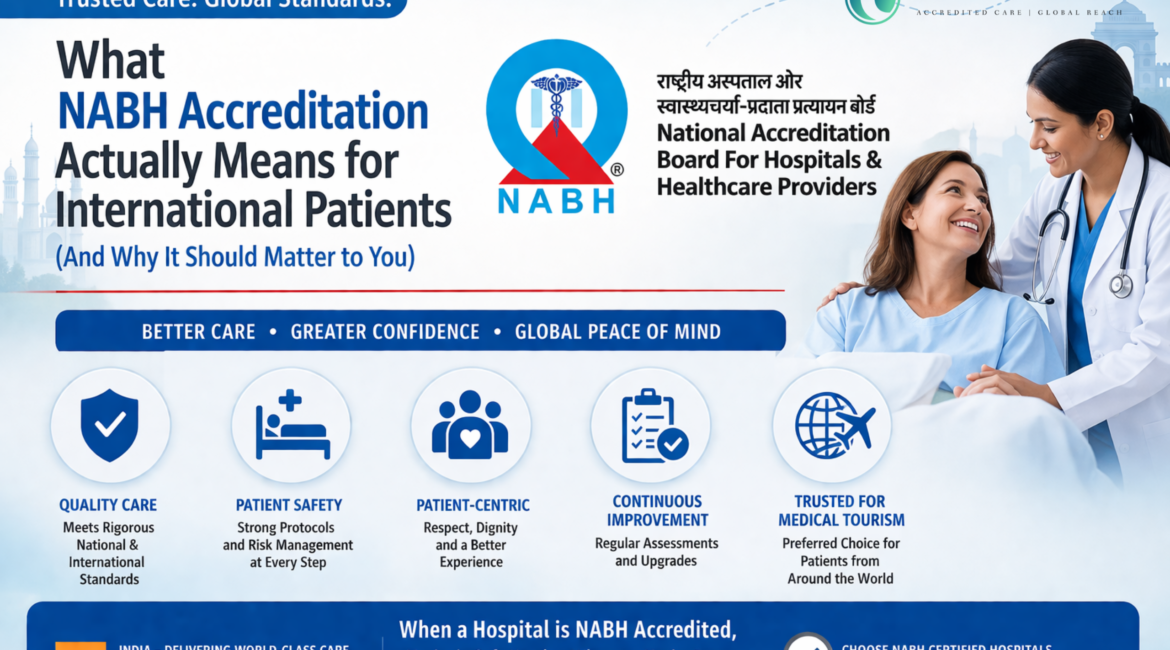
NABH stands for the National Accreditation Board for Hospitals & Healthcare Providers. It’s a constituent board of the Quality Council of India (QCI), set up under the Ministry of Commerce and Industry. Think of it as India’s own version of a gold-standard hospital certification body.
When a hospital earns NABH accreditation, it means an independent team of assessors has walked through every department, reviewed every process, and verified that the hospital meets a rigorous set of benchmarks from how medications are stored to how patient complaints are handled.
The process isn’t quick or easy. Hospitals typically spend 12 to 24 months preparing before they even apply. And once accredited, they face re-assessments every three years to make sure standards are maintained. It’s not a certificate you earn once and frame on the wall.
Why NABH Accreditation for International Patients Carries Extra Weight
NABH has a specific tier designed with global healthcare travelers in mind: the NABH International Entry Level Accreditation and the full NABH International Accreditation. These aren’t simply domestic standards with a different badge. They’re aligned with international norms particularly those set by the International Society for Quality in Health Care (ISQua), the body that benchmarks accreditation programs worldwide.
For you as an international patient, this matters because:
- The standards account for cross-border patient needs language access, documentation in English, international insurance coordination
- Hospitals are assessed on how they communicate treatment plans to patients who may not speak the local language
- International billing practices and medical record formats are part of the evaluation
If a hospital holds NABH international accreditation, it has specifically demonstrated readiness to serve patients from outside India, not just local communities.
What Patient Safety Standards Does NABH Actually Enforce?
This is where things get tangible. NABH accreditation isn’t just about paperwork and policies. It enforces concrete, patient facing safety standards across several critical areas.Sohel@_88980$
Infection Control and Hygiene Protocols
NABH-certified hospitals in India are required to follow documented infection prevention programs. This includes hand hygiene compliance tracking, sterilization standards for surgical equipment, and protocols for isolating patients with infectious conditions. For international patients who may have different baseline immunity than local populations this isn’t a minor point.
Medication Safety
Hospitals must demonstrate clear systems for prescribing, dispensing, and administering medications. That means double-checks for high-risk drugs, allergy verification procedures, and documentation standards that reduce the risk of errors something particularly important when you’re receiving care far from your regular doctors who know your history.
Surgical and Procedural Safety
NABH-accredited facilities follow surgical safety checklists modeled on WHO standards. These include pre-operative site markings, anesthesia safety protocols, and postoperative monitoring requirements. Essentially, your surgery should follow the same fundamental safety choreography as it would in a well run hospital anywhere in the world.
Patient Rights and Informed Consent
One area that catches many international patients off guard is how well their rights are protected. NABH standards require hospitals to inform patients of their diagnosis, treatment options, risks, and costs in a language or format they can understand before obtaining consent. You should never be in the position of agreeing to something you didn’t fully understand.
How NABH Certified Hospitals India Compare to Global Standards
A common question from medical tourists is: “Is NABH as good as JCI (Joint Commission International)?” It’s a fair comparison.
JCI is US-based and widely considered the global benchmark. Many international insurance providers specifically recognize JCI-accredited hospitals. NABH, while an Indian standard, is ISQua accredited meaning it meets the same meta-standards that JCI does. In practical terms, the care standards are comparable.
What NABH does that JCI doesn’t is provide more granular, India-specific requirements. A JCI audit is standardized globally; a NABH audit accounts for the realities of Indian healthcare infrastructure, staff training pipelines, and regional health challenges. For a patient being treated in India, that contextual specificity can actually be an advantage.
Some hospitals hold both NABH and JCI accreditation. If international insurance reimbursement is important to you, it’s worth checking with your insurer which accreditations they recognize.
What NABH Accreditation Doesn’t Guarantee
Honesty matters here. NABH accreditation is a strong signal of institutional quality but it’s not a guarantee of a perfect outcome, and it’s worth being clear eyed about what it covers and what it doesn’t.
It’s a snapshot, not a live feed. Accreditation is assessed periodically. A hospital that earned its badge two years ago may have had staff turnover, infrastructure changes, or shifts in management since then. The standard doesn’t update in real time.
It covers the institution, not individual surgeons. The accreditation tells you the hospital’s systems and processes meet a standard. It doesn’t tell you about the specific credentials, experience, or outcomes of the surgeon who’ll be operating on you. You should research that separately look for board certifications, fellowship training, and published outcomes data if available.
It doesn’t eliminate language or cultural barriers entirely. While NABH international standards include requirements around communication, the actual quality of interpretation services, written materials, and staff training varies from hospital to hospital.
Think of NABH accreditation as a necessary filter, not a sufficient one. It rules out hospitals that shouldn’t be on your list. It doesn’t automatically crown the best one for your specific needs.
How to Verify NABH Accreditation Before You Book
This step is non-negotiable. Don’t just take a hospital’s word for it or even their website’s word for it. Here’s how to verify:
- Check the official NABH portal. The Quality Council of India maintains a publicly accessible database of all currently accredited facilities at nabh.co. You can search by hospital name, city, or accreditation type.
- Look for the accreditation certificate and its validity date. Accreditation has an expiry period. A hospital that was accredited in 2019 may no longer hold valid certification.
- Distinguish between Entry Level and Full Accreditation. NABH has progressive tiers. Entry Level accreditation indicates a hospital on the accreditation pathway it’s meaningful progress, but it’s not the full standard. For complex procedures, you want a fully accredited facility.
- Ask the hospital directly for their accreditation certificate number. A legitimate facility will provide this without hesitation.
Practical Tips for International Patients Choosing a Hospital in India
Beyond verifying NABH status, here are a few more things worth checking as you evaluate your options:
Ask for an International Patient Coordinator. NABH international accredited hospitals typically have a dedicated coordinator whose job is to manage the end-to-end experience for foreign patients from visa assistance to discharge summaries formatted for your home country’s medical records system. If a hospital doesn’t have this role, that’s a signal worth noting.
Request outcome data for your procedure. For high stakes interventions like cardiac surgery, oncology treatments, or orthopedic replacements, ask about the hospital’s volume and outcomes for that specific procedure. Higher volume generally correlates with better outcomes.
Understand the billing model before you commit. Medical tourism hospitals in India typically offer package pricing for international patients. Get everything in writing what the package includes, what costs are excluded, and what happens financially if complications arise.
Check international insurance recognition. Confirm whether your insurer recognizes NABH accreditation for reimbursement purposes, or whether they require JCI.
FAQ: NABH Accreditation for International Patients
Q: Is NABH accreditation mandatory for hospitals treating international patients in India?
No, it’s not legally mandatory. However, the Indian government and medical tourism facilitation bodies strongly promote NABH-accredited hospitals for international patients. Practically speaking, most reputable facilitators and medical tourism packages will only feature accredited hospitals.
Q: How is NABH different from NABL accreditation?
NABH accredits hospitals and healthcare facilities as whole institutions. NABL (National Accreditation Board for Testing and Calibration Laboratories) specifically accredits medical laboratories and diagnostic centers. A hospital can hold both, and for international patients requiring lab-intensive diagnostics, it’s worth checking whether the on-site lab is NABL accredited.
Q: Does NABH accreditation cover hospitals across all Indian cities?
Yes, NABH operates nationally. Accredited hospitals exist across major medical hubs including Delhi, Mumbai, Chennai, Hyderabad, Bengaluru, and Ahmedabad, among others. The concentration is higher in metro cities, but tier-2 cities are increasingly represented as well.
Q: Can I trust a hospital that has NABH Entry Level accreditation but not full accreditation?
Entry Level accreditation means the hospital has passed an initial assessment and is committed to the full accreditation process. It’s a meaningful indicator of institutional intent and baseline compliance. For routine or lower-complexity procedures, it may be adequate. For major surgeries or complex chronic disease management, it’s worth prioritizing a fully accredited facility.
Q: How long does NABH accreditation remain valid?
Full NABH accreditation is valid for three years, after which hospitals must undergo reassessment to retain their status. Always verify the current validity of a hospital’s accreditation before making decisions.
Conclusion: Use NABH Accreditation as Your Starting Point
India’s healthcare landscape has genuinely world-class institutions alongside facilities that don’t meet global standards. NABH accreditation is the clearest, most reliable filter available to international patients navigating that landscape from a distance.
When you see NABH certification especially NABH International Accreditation it tells you that an independent body has verified the hospital’s commitment to patient safety, quality processes, and institutional accountability. It’s not a guarantee of perfection, but it’s a well established, internationally recognized signal that matters.
Use it as your starting point: verify it, combine it with your own research on surgeon credentials and procedure NABH accreditation for international patientsspecific outcomes, and ask the right questions before you book.
Considering treatment in India? Speak with a certified medical tourism facilitator who works exclusively with NABH-accredited hospitals. A good facilitator doesn’t just book your flight and hospital room they help you understand your options, review your medical records, and connect you with the right specialists for your specific condition. Your health is worth that level of care in the planning stage, not just in the operating theater.